

An “I” statement can still carry blame. “I feel that you are selfish” begins with a pronoun but delivers a judgment about the other person. A clearer statement describes the event, its effect and what you want to discuss.
Use the examples here as starting points in your own voice. The aim is honest communication with room for a response, while keeping your needs and boundaries clear. You do not need perfect wording to deserve respect.
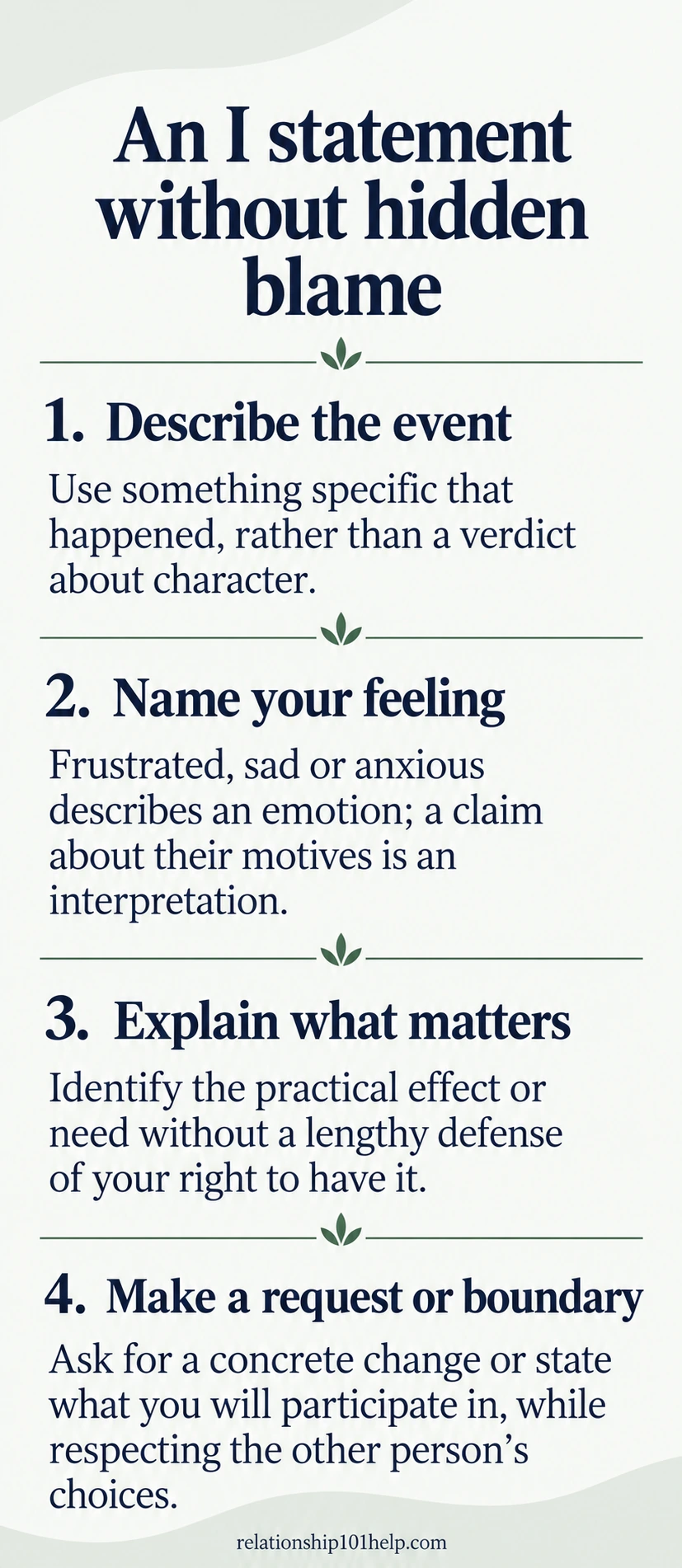
Build a clear statement in four parts
Read the guide as text
- Describe the event. Use something specific that happened, rather than a verdict about character.
- Name your feeling. Frustrated, sad or anxious describes an emotion; a claim about their motives is an interpretation.
- Explain what matters. Identify the practical effect or need without a lengthy defense of your right to have it.
- Make a request or boundary. Ask for a concrete change or state what you will participate in, while respecting the other person’s choices.
Understanding the Reason Behind the Statement
Using an "I" statement helps you take responsibility for talking about what you're seeing. It gives the other person information about what you've noticed, how it affected you, and what you want to talk about. It doesn't mean that you're taking responsibility for someone else's choices. You could say something like, "I felt scared when you blocked the door." This names a serious behavior, but you don't have to make it easier for them by making it part of the conversation.
The Centre for Clinical Interventions explains assertive communication as expressing needs directly while respecting other people. An I statement can support that approach when the surrounding conversation allows both people to have a voice.
Think of the statement as an opening, not a verdict of what is going to happen. Your partner might remember what happened differently than you do, have information, or decline to talk about it. A good opening makes responses possible without requiring you to ignore your concern.
Break Down What You Want to Say
Sometimes when you're upset with your partner, it can be difficult to explain exactly what's bothering you without letting your emotions take over. One thing that might help is breaking your thoughts into four simple parts before having the conversation. Think about what happened, how it made you feel, why it bothered you, and what you'd like your partner to do differently.
For example, you might say, "When our dinner plans changed after I'd already started cooking, I felt frustrated because I'd planned my evening around eating together. Could we try letting each other know about changes before either of us starts preparing dinner?" This helps your partner understand what happened and what you're asking for without turning the conversation into an argument about who's right or wrong.
But remember that you don't have to follow these four steps every time you express your feelings. Sometimes saying something simple like, "I'm disappointed about what happened, and I need a little time before I'm ready to talk about it," is enough. The purpose of organizing your thoughts is to make communication easier, not to make every conversation feel like you're following a script.
You also don't need to spend a long time defending why something matters to you. Wanting privacy, respect, rest, or a little notice when plans change are reasonable needs to communicate. Try explaining enough so your partner understands where you're coming from and then give them an opportunity to respond.
The important thing is making sure you're expressing your feelings clearly while leaving room for both people to participate in the conversation.
Focus on What Actually Happened
When you're bringing up a concern with your partner, try starting with something specific that happened instead of making a general statement about their behavior. For example, saying, "We ended up having dinner an hour later than we'd planned," is easier to discuss than saying, "You never respect my time."
If you're not completely sure about what happened or what was agreed upon, it's okay to ask for clarification. You might say, "I thought we agreed to have dinner at six. Did you understand our plans differently?" This gives your partner a chance to explain their understanding without making it seem like your memory of the situation is automatically the only correct one.

It's also a good idea to be careful with words like "always" and "never." When you say something like, "You always change our plans," your partner might immediately start thinking about all the times they didn't. Before long, you're arguing about whether the statement is true instead of discussing what actually bothered you.
But this doesn't mean you have to ignore problems that keep happening. If your partner has changed your plans at the last minute for the past three weekends, it's okay to bring that up. You might say, "Our plans have changed at the last minute for the past three weekends, and it's becoming frustrating because I don't know what to expect."
This helps you explain that there's an ongoing problem without making it sound like your partner is permanently inconsiderate or incapable of changing.
The goal is to focus on specific situations and patterns instead of making assumptions about someone's character. When both people understand what's actually happening, it's easier to discuss the problem and find a solution that works for the relationship.
Feelings Aren’t Interpretations
Distinguish feelings from interpretations.
Sad, anxious, disappointed, angry, lonely and relieved describe feelings. "You do not think I am important" is an interpretation of another person's thoughts. The feeling can be real while that interpretation remains uncertain.
You do not need to hide the meaning you took from an interaction. Separate the observable event, your emotion and the interpretation so each can be discussed.
For example: "When the discussion moved on before I finished, I felt hurt and wondered whether my point mattered. Could we come back to it?" This identifies the event, feeling and question without claiming to know the other person's intention.
Check the interpretation with a question such as, "Was that how you understood what happened?" Their explanation may clarify a misunderstanding without erasing the impact or removing the need for change.
Don’t Judge
“I feel like you’re lazy,” and “I feel that you only care about your own self,” are judgements. Just because you say the word "feel" doesn't mean the descriptions are emotions. Ask what behavior made you come to this conclusion. Was it something they didn't finish, a message they didn't answer, or a plan that was changed? Then talk about the effect it had on you personally.
Mayo Clinic's anger-management guidance discusses using I statements to express a problem specifically rather than relying on blame. The practical value comes from the whole message, not the pronoun alone.
You don't need to hide your concern in neutral-sounding language. You can say, "I'm worried that you're not being fair with the responsibilities." This is direct. Follow this with examples and an explanation of why you need to relook at the arrangement. This is more helpful than just making accusations, even if you're being polite.
Be Clear About What You're Asking For
When you're talking to your partner about something that's bothering you, try being specific about what you'd like them to do differently. For example, saying, "Could you send me a quick message if you're going to be late?" is much easier to understand than saying, "I just need you to care about me more." The first statement explains what you're asking for and gives your partner something they can actually respond to.
It's also important to think about whether your request is realistic. Your partner might not be able to send messages while driving, working, or handling other responsibilities. Instead of expecting them to respond whenever you want, talk about an arrangement that works for both of you.
Remember that making a request and setting a boundary aren't the same thing. For example, saying, "Could we talk about this tomorrow?" gives your partner an opportunity to agree on a time. But saying, "I'm not going to continue this conversation if we're calling each other names," explains what you're willing to participate in. Both can be helpful, but they serve different purposes.
But just because you're using a gentle tone doesn't mean every request is automatically reasonable. For example, saying, "I feel anxious, so I need access to all your passwords," might explain how you're feeling, but it doesn't mean your partner has to give up their privacy. The same applies to demands involving money, physical affection, sex, or other personal boundaries.
The important thing is learning how to express what you need while still respecting your partner's choices and personal boundaries. Healthy communication should help both people understand each other instead of making one person feel pressured to agree.
A Better Way to Talk About Household Responsibilities
Sometimes disagreements about chores can turn into arguments about how much effort each person puts into the relationship. When you're frustrated, you might say something like, "I feel like I'm the only adult in this house." Even though you're trying to explain how overwhelmed you feel that statement can make your partner feel insulted instead of helping them understand the problem.
A better approach might be to say, "The trash cans were still full when I left this morning, so I took them out before work. I felt frustrated because we'd agreed that it was something you were going to handle. Can we talk about how we're going to manage that responsibility?"
This explains exactly what happened, why it bothered you, and what you'd like to discuss. Instead of making your partner feel like you're questioning their maturity, you're focusing on a specific task and an agreement that wasn't followed.
Of course, your partner's response might help you understand the situation differently. Maybe they forgot, misunderstood the arrangement, or thought the responsibility had changed. But it's also possible that they've repeatedly ignored something they agreed to do.
That's why it's important to listen to their explanation while also paying attention to what happens as time goes on. One forgotten chore is different from a pattern of constantly leaving responsibilities for someone else to handle.
Remember that communicating more clearly doesn't mean you have to overlook repeated broken promises or take on every responsibility yourself. It simply gives both people a better opportunity to understand the problem and decide how to handle it.
The goal is to discuss household responsibilities without turning every disagreement into an argument about someone's character. When both people understand what's expected and follow through on their commitments, it's easier to share responsibilities and avoid unnecessary frustration.
Rewrite the Complaint
Say, "I feel that your phone matters to you more than I do." This is hidden blame. A better thing to say would be, "I missed having your attention when we were eating dinner, and we were both scrolling. I would like some time to talk without our phones. Would you have 15 minutes after we eat so we can sit down and just talk without our phones?"
See that the change example includes your own point of view that's accurate. Don't create a shared responsibility just to make the request sound more balanced. You can also ask about the other person's needs, such as, "Are you waiting for an important message, or would another time work better for you?" This allows room without making your wish disappear.
A partner might want a different amount of time or a different setting. Negotiating a request should be part of the conversation. The connection can still be important even if the first solution doesn't work for both partners.
Rewriting a Family Boundary
If you say, "I feel you let our family control our life. This is hidden blame." A better version would be: "When overnight guests are invited before we talk about it, it makes me feel overwhelmed because it affects my rest and my preparation. I'd like us to agree before we confirm a stay."
The concern isn't whether the family is bad or whether the partner loves them too much, but it's a shared decision that affects the home. If your partner says that family visits are important to them, you can understand this while keeping a limit. You can say, "I understand you want them to feel welcome, but I also need to be able to have a say in overnight plans."
This doesn't mean that every disagreement can be solved by saying kind words. You might still have different expectations about family access. The statement makes these expectations visible enough to talk about them and then can help you decide if an agreement is possible.
Talk About Privacy Without Blaming Your Partner
When you're upset because your partner has crossed a personal boundary, it's easy to say something that sounds more like an accusation than an explanation of how you feel. For example, you might say, "I feel like you're being suspicious and controlling every time you ask about my messages." Even though you're trying to explain your feelings, this can make your partner feel attacked and turn the conversation into another argument.
Instead, try focusing on what actually happened and what you'd like to change. You might say, "I feel uncomfortable when you read my messages without asking. I don't mind you borrowing my phone for something, but I'd like us to agree that doesn't mean it's okay to look through my private conversations."
This gives your partner a clear understanding of what bothered you without assuming you know exactly why they did it. You can still ask what made them concerned enough to look through your messages while making it clear that your privacy deserves to be respected.
But if your partner is constantly monitoring your messages, threatening you, or making you afraid to set boundaries, having a direct conversation might not be the safest option. In those situations, getting help from someone who understands controlling behavior or relationship abuse might be more appropriate.
Remember that using "I statements" doesn't mean you have to make every boundary sound like a request your partner can decide whether to respect. You can explain your feelings kindly while still being firm about what you're comfortable with.
The important thing is communicating your concerns without unnecessary blame while remembering that your personal boundaries still matter, even when your partner doesn't agree with them.
Listen to Your Partner Without Losing Your Point
After explaining how you feel, it's important to give your partner an opportunity to respond. Sometimes people become so focused on making sure their feelings are heard that they forget to listen to the other person's perspective.
Try not to keep repeating something like, "Well, that's how I feel," whenever your partner asks a question or tries to explain what happened. Your feelings are important, but that doesn't automatically mean every assumption you've made about the situation is correct.
For example, imagine that you're upset because your partner didn't respond to a message about your dinner plans. You might feel like they ignored you or didn't care about your time. But when you talk about it, your partner explains that they thought you already knew about a schedule change.
Instead of immediately dismissing their explanation, you could say, "I understand that you thought I'd seen the message, but I hadn't. I was still planning around the original time." This gives both people a chance to understand what happened without ignoring either person's feelings.
Sometimes your partner might also bring up something that's been bothering them during the conversation. If their concern is connected to what you're discussing, it might make sense to talk about it together. But if it's a completely different issue, you don't have to abandon your original concern to address it immediately.
You might say, "I want to hear what's bothering you, too, but can we finish talking about this first and then make time for your concern?"
The goal is to make sure both people feel heard and respected. Listening doesn't mean you have to agree with everything your partner says or forget why you started the conversation. It simply means being willing to understand their perspective while still communicating your own needs.
Repairing Your Wording
You might see when you start talking that you made an accusation. Stop and restart the conversation. You can say something like, "That sounded like a judgment. Let me describe the part I want to talk about."
A repair is helpful and doesn't mean you have to have a long argument about whether the other person was being too sensitive or not. You can pay attention to your wording without agreeing that a concern was invalid.
If the conversation gets too heated, ask for a pause and a plan to return. Use the time to calm down and clarify one point instead of trying to come up with a bigger accusation.
Do this with low-stakes issues first. Ask for a clearer meal plan or a quieter work period instead of talking about the relationship's most painful situations. Being familiar can help the language sound more like your own voice instead of like you're trying to use techniques on your partner.
Put Safety First
Using an "I" statement is a communication tool, not a test you have to pass before your needs need attention. You're allowed to be upset, direct, and imperfect. If your partner keeps ignoring a boundary, the next step might involve taking action, getting support, or changing your mind about the relationship. This doesn't always involve looking for a better sentence to say.
If you're in an abusive situation, your safety matters more than using the right kind of language. Get private specialist help if talking openly could trigger retaliation. No phrasing makes you responsible for another person's threats or violence.
For regular disagreements, use a simple check: "Did I talk about the event, show the difference in my interpretation, and make a clear boundary?" Then listen to the response. The purpose is to have an honest conversation with room for both people instead of blaming.
Build an I statement with a clear request
Choose an observable situation and a feeling. Review the draft so it accurately describes your experience.
Clear wording cannot guarantee a safe or cooperative response. Fear, coercion or retaliation calls for private support.
Use the questions and examples in the article above; the draft builder needs JavaScript.
15 questions readers ask
1. What is an I statement?
It is a way to describe your experience and concern, often including an event, feeling, need and request. The pronoun alone does not make the statement constructive.
2. Is 'I feel you are selfish' an I statement?
It starts with I but still judges character. Describe the behavior and its effect instead.
3. How do feelings differ from interpretations?
Frustrated or lonely names an emotion. Saying someone does not care assigns meaning or motive that may need checking.
4. Do I have to use a four-part formula?
No. A simple direct sentence may be enough. Use structure to clarify your thought, not to sound like a worksheet.
5. Can I name a repeated pattern?
Yes. Give specific examples or a defined period instead of relying on always or never.
6. What is an example about changed plans?
You might say that the late change disrupted your evening and ask to confirm plans before cooking or buying food.
7. How can I discuss chores without an insult?
Name the task and agreement, explain the effect and ask to review responsibility. Avoid turning one event into a verdict about maturity.
8. What is a request?
A request asks for a specific response and leaves room to discuss it. Check whether it is realistic in the person's circumstances.
9. How is a boundary different?
A boundary states what you will participate in or allow. It does not need to be framed as permission for someone else to disregard it.
10. Does feeling anxious justify demanding passwords?
No. A real feeling does not automatically make a demand fair. Discuss the concern while respecting privacy and choice.
11. Can I discuss family visits this way?
Yes. Describe how invitations affect your rest or preparation and ask for agreement before confirming overnight guests.
12. Should I invent shared blame to sound balanced?
No. Describe your own part accurately without making yourself responsible for someone else's choices.
13. What if my partner remembers the event differently?
Listen and clarify the disagreement while keeping your concern visible. Feelings can matter without making every assumption correct.
14. How do I repair accusatory wording?
Pause and say you want to describe the specific concern more clearly. A wording repair does not mean the underlying concern was invalid.
15. Can I statements stop abuse?
No communication formula makes another person safe. If honesty brings threats or retaliation, prioritize private specialist support and safety.