

Meditation can offer a little space to notice what is happening in your mind and around you. You do not need to feel peaceful, stop every thought or become a different person to try it.
A short practice may suit you, or you may prefer another way to pause. Start with curiosity, keep the experience optional and judge it by how it affects you rather than by promises about what it should achieve.
On this page
- Understand what you are trying
- Set realistic expectations about benefits
- Choose a comfortable place and a modest length
- Try a short, flexible practice
- Let thoughts come and go
- Notice discomfort and give yourself alternatives
- Keep care and relationship work practical
- Review the experiment without grading yourself
Understand what you are trying
Meditation describes several kinds of practice. Some involve returning attention to a sensation, sound or phrase; mindfulness often involves noticing the present moment without immediately judging what you find.
You can approach a practice spiritually, secularly or simply as an experiment in attention. Choose a description that fits your beliefs without assuming that a particular method will produce a particular result.
Set realistic expectations about benefits
The National Center for Complementary and Integrative Health’s overview describes possible benefits for some concerns, alongside important limits in the research. Studies use different practices and participants, and some findings are preliminary or affected by study quality.
That does not mean you have to dismiss an experience you find helpful. It does mean that improved memory, relief from depression or a transformed relationship should not be promised as the expected reward for regular practice.
A useful personal question is smaller: “Does this brief pause help me notice what I need next?” Your answer can change from day to day.

Choose a comfortable place and a modest length
Pick a place where you can sit, stand or lie down comfortably and stop freely. You do not need a special cushion, a silent room or an expensive course. Avoid practising while driving or doing anything that needs your full attention.
Try a minute or two if that feels manageable. Keep your eyes open if you prefer, and choose an ordinary point of attention such as a sound in the room or the feeling of your feet on the floor.
Try a short, flexible practice
First, notice where you are and how you are supported. Let your breathing remain natural; there is no need to force a deep breath or hold it.
Next, choose one comfortable sensation or sound to notice. When your attention moves elsewhere, gently return if you want to. If following your breath feels unpleasant, choose an external sound or look at a familiar object instead.
Finally, look around and decide what you need. That might be continuing, stretching, getting a drink or returning to an ordinary task. Ending early is allowed.
Let thoughts come and go
Thinking during meditation is not a failed attempt. The NHS introduction to mindfulness explains that the aim is not to make thoughts disappear.
You might briefly notice “planning” or “worrying” and then return to your chosen focus. You do not have to solve the thought, argue with it or treat it as a message requiring action. If naming thoughts feels like extra work, leave that step out.
Notice discomfort and give yourself alternatives
Meditation is not right for everyone. Stop if the practice makes you feel increasingly distressed, frightened, disconnected or otherwise worse. Opening your eyes, looking around or moving to another activity may be more comfortable.
A slow walk, noticing sounds outdoors or doing a familiar task with attention can offer a different kind of pause. There is no requirement to return to a practice that does not suit you. Persistent or worrying symptoms deserve appropriate support.
Keep care and relationship work practical
Meditation should not replace or delay needed healthcare. If you are considering it for a health concern, discuss suitable options with a qualified professional, especially if previous practices have been unsettling.
A pause also does not replace a conversation, an apology or a change in behaviour. If you notice that you are angry with a partner, the next useful step may be arranging a calmer time to discuss the actual problem. You are not obliged to become calm enough to tolerate mistreatment.
Review the experiment without grading yourself
After a few attempts, ask whether the practice is useful, neutral or uncomfortable. You can shorten it, change the focus, choose a different activity or stop.
Let your decision be practical: “I like a quiet minute before a conversation,” or “Walking suits me better than sitting.” A routine is worth keeping when it supports your life, rather than becoming another task you feel guilty about.
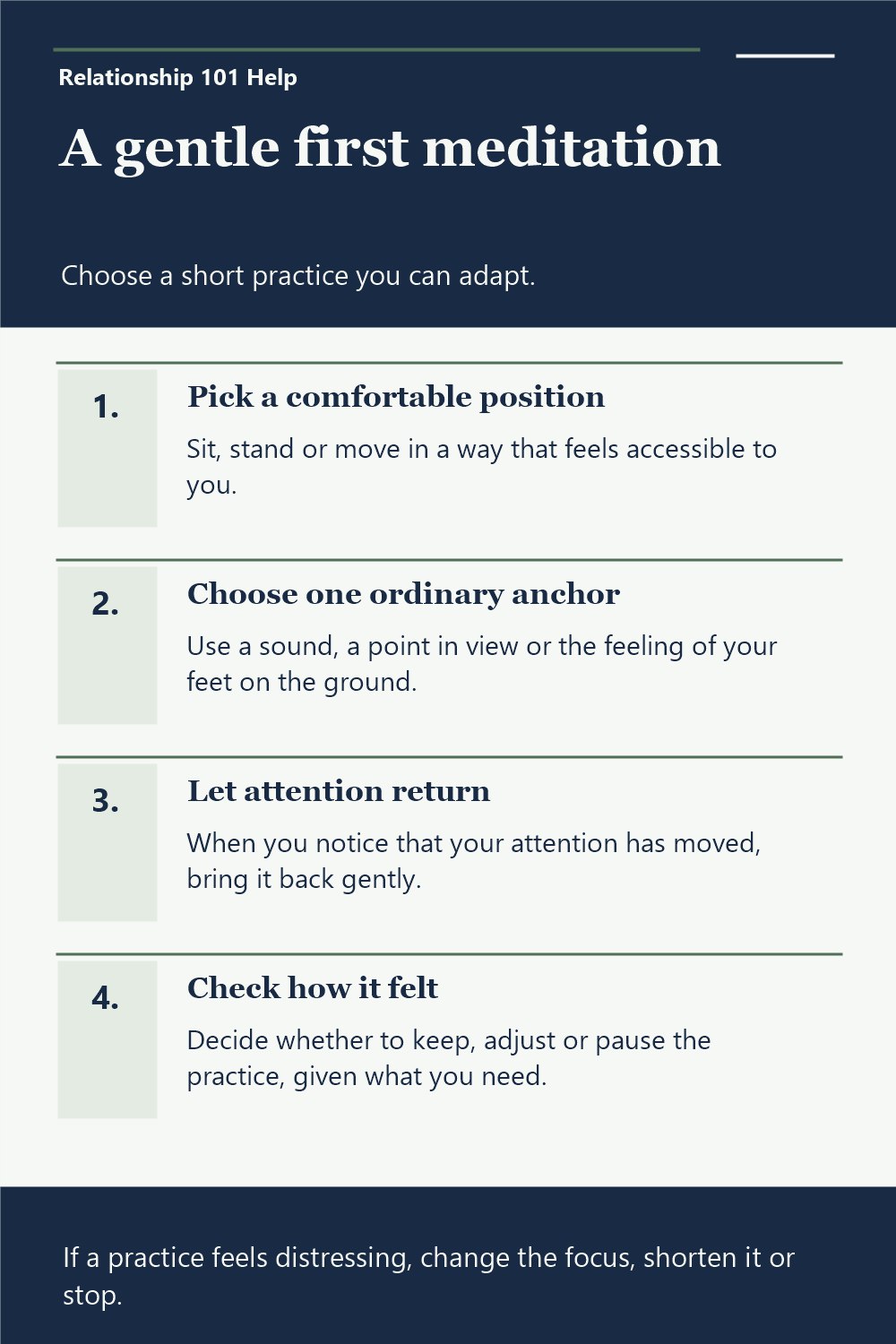
Read the infographic in text
A gentle first meditation
Choose a short practice you can adapt.
- Pick a comfortable position Sit, stand or move in a way that feels accessible to you.
- Choose one ordinary anchor Use a sound, a point in view or the feeling of your feet on the ground.
- Let attention return When you notice that your attention has moved, bring it back gently.
- Check how it felt Decide whether to keep, adjust or pause the practice, given what you need.
If a practice feels distressing, change the focus, shorten it or stop.