

When you like someone, small moments can feel significant: he remembers a detail, makes a plan or says he misses you. Those moments may show affection, but they cannot tell you exactly what he feels or whether you want the same relationship.
You can enjoy getting closer without turning every gesture into evidence. Look at how you treat each other over time, ask about the things that matter and leave room for an honest answer.
On this page
Notice affection without treating it as proof
Men do not all express love in one way, and women do not all want the same signs. Gender rules such as “men fall faster” will not explain this particular person’s feelings. His words, actions and willingness to answer questions are more useful than a general checklist.
A smile, eye contact or nervousness can have several meanings. You might notice warmth without deciding that you have uncovered a hidden declaration. If he says something affectionate, ask what he means when you need clarity.
Jealousy is not a reliable sign of love. Monitoring your messages, questioning your friendships or demanding reassurance through restrictions deserves attention in its own right. You do not have to accept controlling behaviour because someone says it comes from caring.
Look for respect in everyday behaviour
People differ in how comfortable they are with eye contact, touch and conversation. Look beyond a particular mannerism: can you express a preference, disagree or say no without being punished? Does he take your answer seriously?
Care can include enjoying your happiness and supporting your interests. It does not require either person to stay cheerful, entertain the other constantly or take responsibility for every difficult mood.
Time together matters, but permanent availability is not the test. Work, children, health and other commitments can limit time. Notice whether plans are realistic, changes are communicated and the arrangement leaves room for both people’s needs.
Frequent messages may be welcome or overwhelming. Rather than counting them, discuss a comfortable rhythm. Surprise visits should also fit your preferences; being romantically interested does not give someone automatic access to your home or workplace.
Physical affection should be something you both want. A kiss, sexual desire or an intimate encounter does not establish commitment. You can slow down, change your mind or ask about the relationship without owing more physical closeness.
Thoughtful gifts and favours can be pleasant, but they do not create a debt. Expensive presents, grand sacrifices or early intensity are not substitutes for steady respect. You are allowed to decline a gift or an arrangement that makes you uncomfortable.
Listening is useful when it leads to understanding: remembering an important limit, asking before offering advice or acknowledging a mistake. You need not expect perfect memory. Look for willingness to repair ordinary misunderstandings rather than performing an ideal romance.
Talk about feelings and commitment
Future plans can mean different things. “We should travel sometime” is different from agreeing on a shared commitment. Ask about what is being offered now instead of relying entirely on an imagined future.
There is no universal deadline for saying “I love you.” You can nevertheless have your own limits around uncertainty. A conversation might begin: “I’m enjoying getting closer. What are you hoping this relationship will become?”
Separate feelings from agreements. Someone may care about you while wanting a casual relationship, or want exclusivity before using the word love. Discuss exclusivity, contact and other expectations explicitly; affection alone does not settle them.
If he is unsure, ask what that means in practice without demanding a promise. You might agree to revisit the conversation, if both of you want to. You may also decide that waiting does not work for you.
Having shared interests can make time together enjoyable, while different interests can leave room for individuality. Neither proves compatibility on its own. Talk about the decisions that affect you both, including time, responsibilities and how you handle disagreement.
A difficult past or fear of closeness may be something he chooses to discuss. It does not make pressure, insults or repeated broken agreements acceptable. You can care about his experiences while expecting respectful treatment.
Bring your own answer to the conversation too: “I’d like an exclusive relationship, and I want to know whether that’s something you want.” Being clear about your preferences is different from persuading him to share them.
Attraction and compliments can be part of romance, but comments about your body do not tell you whether he loves you. Pay attention to whether you feel heard as a whole person and whether the connection fits what you want.
Respond to uncertainty and concerns
Your feelings matter even if his are different. You are not obliged to return a declaration, stay because he loves you or keep dating until you feel certain. Both people need room to choose.
Likewise, love does not require giving up friends, privacy or independent plans. Notice whether closeness leaves room for those parts of your life. Dependence and constant access are not proof of greater commitment.
If the relationship is mainly physical and you want more, say so. There is no technique that reliably turns desire into love. An answer that disappoints you can still give you information for your own decision.
Avoid diagnosing him as emotionally unavailable or explaining every mixed message through a disorder. Describe the behaviour and its effect instead: “Our plans keep being cancelled, and this arrangement isn’t working for me.” If there are threats, coercion or fear, consider individual support and practical planning for a controlling relationship.
Decide what works for you
After a conversation, compare the answer with everyday behaviour and your own needs. Do you understand what you are agreeing to? Can you say no? Is there room to discuss concerns? You do not need certainty about every private feeling to decide whether the relationship suits you.
If you want different things, that difference may be enough to step back. If you both want to continue, choose one practical agreement and see whether you can keep it. A relationship grows through mutual participation, not through passing a hidden test.
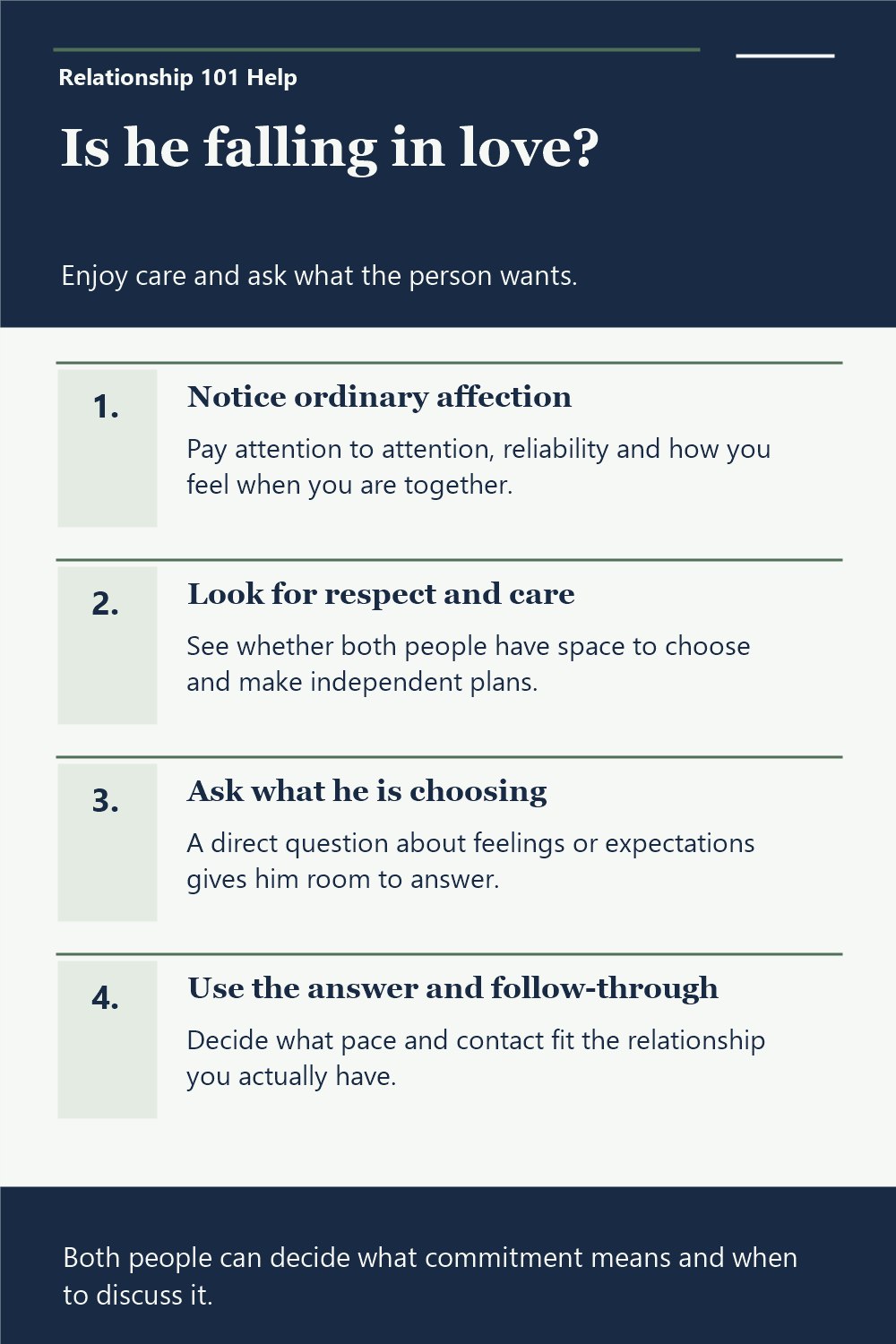
Read the infographic in text
Is he falling in love?
Enjoy care and ask what the person wants.
- Notice ordinary affection Pay attention to attention, reliability and how you feel when you are together.
- Look for respect and care See whether both people have space to choose and make independent plans.
- Ask what he is choosing A direct question about feelings or expectations gives him room to answer.
- Use the answer and follow-through Decide what pace and contact fit the relationship you actually have.
Both people can decide what commitment means and when to discuss it.