

Healthy relationship basics show up in ordinary choices: keeping a commitment, asking before a plan affects both people, respecting a refusal and making room for separate interests. They are easier to understand through behavior than through a perfect-couple image.
Respect, trust and freedom should work together. You can be close while retaining privacy, friendships, changing needs and a meaningful voice in shared decisions.
Look for these foundations in an ordinary week
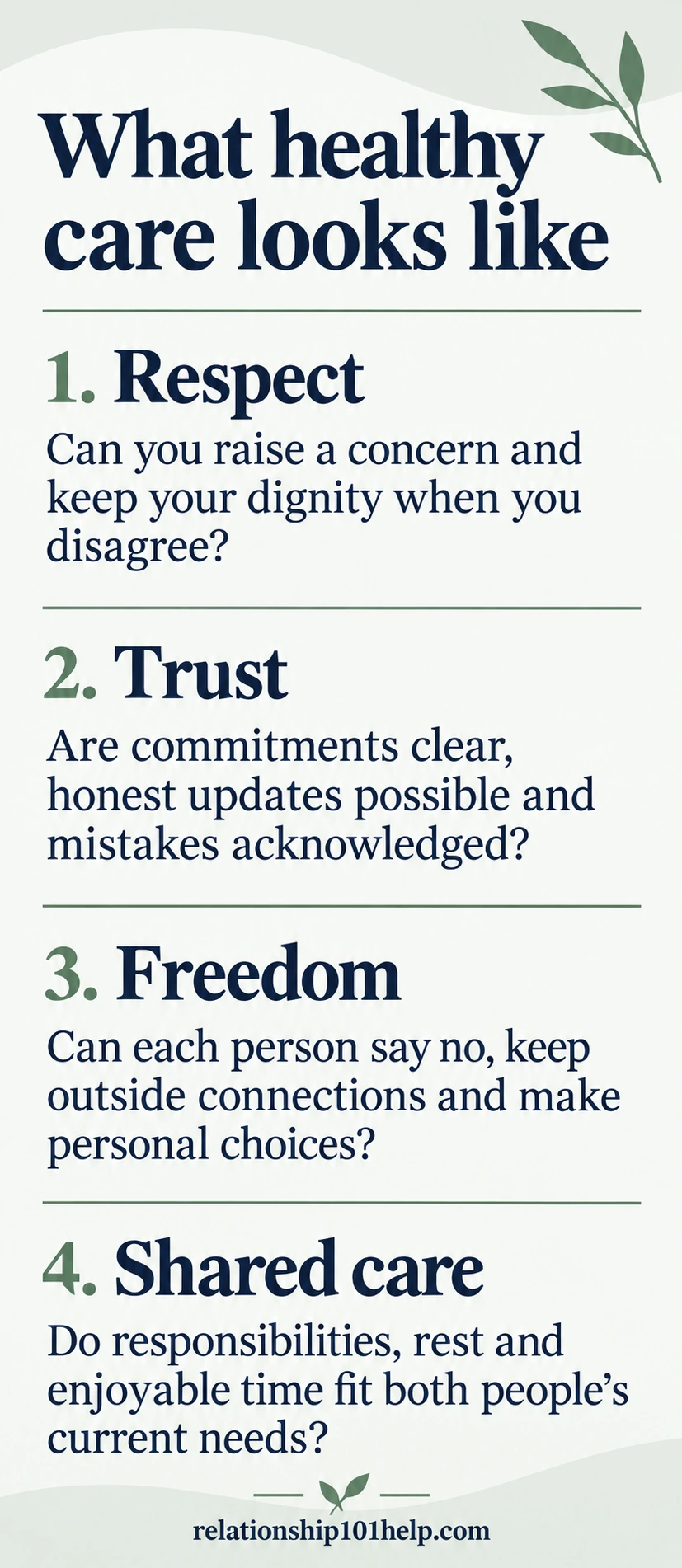
Read the guide as text
- Respect. Can you raise a concern and keep your dignity when you disagree?
- Trust. Are commitments clear, honest updates possible and mistakes acknowledged?
- Freedom. Can each person say no, keep outside connections and make personal choices?
- Shared care. Do responsibilities, rest and enjoyable time fit both people’s current needs?
Look at Regular Life
An enjoyable holiday or an affectionate social-media post shows one part of a relationship. Everyday decisions reveal more about how you treat each other: what happens when someone is late, shares good news or needs to change a plan. Look at those ordinary interactions alongside the memorable moments.
Love is respect identifies communication, boundaries, mutual respect and support as healthy relationship foundations. Use those ideas to examine daily experience rather than compare appearances.
If your partner hardly ever surprises you but checks on you regularly, shares the chores, and listens when there is a concern, those behaviors may matter more to you than surprise gestures. You can still discuss anything that leaves you feeling unheard.
Respecting Each Other
Respect shows in how you speak to each other, consider each other’s time and respond to different preferences. Ask before inviting someone along to a shared plan. Listen when a concern is raised, without mocking or dismissing it.
Respect should never mean that you have to agree with everything. You can say that you understand why something matters to them but that you don’t agree with them and still be curious about the differences.
This goes beyond the room; don’t share embarrassing stories, private medical information, or intimate details without asking for permission. Consider your partner’s privacy when talking with others, while preserving your own access to confidential support.
Build Trust by Following Through on Your Promises
Trust is an important part of any healthy relationship, and one way to build it is by doing what you say you're going to do. You don't have to make big promises or constantly go out of your way to prove that you care. Sometimes the smallest things, like showing up when you say you will or taking care of something you agreed to handle, can make a big difference. What matters is that your partner knows they can depend on you.
It's also important to be clear about what you're agreeing to do. For example, telling your partner, "I'll take care of dinner on Thursday," is different from saying, "I can help with dinner if you need me." The first statement means you're taking responsibility for making dinner, while the second leaves the responsibility with your partner unless they ask for help. Making sure you both understand what's expected can prevent misunderstandings and unnecessary frustration.

Of course, life doesn't always go according to plan, and there might be times when something happens that prevents you from keeping a promise. Maybe your work schedule changes, an unexpected responsibility comes up, or something happens that you couldn't have predicted. When this happens, try to let your partner know as soon as possible instead of waiting until the last minute. You might say something like, "My work schedule changed, so I won't be able to pick you up at six as we planned. Can we figure out another arrangement?" This gives your partner time to make other plans instead of leaving them wondering what happened.
Remember that making a mistake doesn't automatically mean someone can't be trusted. Everyone forgets things or falls short of expectations sometimes. What matters is how the person handles the situation afterward. Acknowledging what happened, being honest about it, trying to make things right, and following through with changes can help rebuild trust.
But there's a difference between someone who occasionally makes a mistake and someone who repeatedly breaks promises, hides information, or denies doing anything wrong. You can be understanding and forgiving without pretending that these behaviors are the same. Trust grows when both people make an effort to be dependable and take responsibility for their actions.
Be Honest Even When You Don't Have Everything Figured Out
Being honest with your partner doesn't mean that you have to know exactly what you want out of life or have every decision figured out. Sometimes you might feel uncertain about something important, and that's okay. What matters is being willing to talk about those feelings instead of agreeing to something simply because you don't want to disappoint your partner or have a difficult conversation.
Maybe your partner wants to move to another state next year, but you're not sure whether you're ready to leave your job, family, or the life you've built. Instead of saying yes just to avoid an argument, you could explain that you're still thinking about it. You might say, "I know moving is something you're excited about, but I'm not sure how I feel about it yet. I need more time to think about what that would mean for me." This gives your partner a more accurate understanding of where you stand.
The same thing applies to other important relationship decisions, such as getting married, having children, combining finances, physical intimacy, or taking on family responsibilities. If you're unsure about something that could affect your future together, it's better to be honest about your uncertainty than to make promises you're not ready to keep. Your partner deserves to understand where things stand before making major decisions based on what they believe you've agreed to.
At the same time, honesty doesn't mean that you have to share every thought or worry that crosses your mind. Sometimes we have temporary doubts or feelings that change as we work through a situation. It's okay to take time to understand your emotions before discussing them. The important thing is not hiding information that could significantly affect your partner's decisions or allowing them to believe something that you know isn't true.
For an illustrative example, imagine Lauren has been dating Michael for several months. They enjoy spending time together, and their relationship seems to be going well. However, Michael begins talking about moving in together, and Lauren realizes that she isn't ready for that kind of commitment. Instead of agreeing because she's afraid of losing him, she explains that she cares about him but wants more time before sharing a home.
This gives Michael the opportunity to think about whether he's comfortable continuing the relationship at its current pace. He might decide that he's willing to give things more time, or he might realize that he wants a relationship that's moving toward a shared home sooner. Neither person has to be wrong for their needs to be different.
Being honest about uncertainty might sometimes lead to uncomfortable conversations, but it can also prevent bigger problems later. When both people understand what the other is thinking and feeling, they have a better chance of making decisions that are right for them. A healthy relationship should leave room for honest conversations, changing feelings, and personal growth without expecting either person to promise something they aren't ready to give.
Keep the Relationship Free
Everyone should be allowed to have their own interests, friendships, beliefs, and privacy. Closeness doesn’t mean that you give up every part of your life. Talk about the time you’re going to spend together and the time you will be apart. An evening with friends does not automatically mean a partner is rejecting the relationship. But at the same time, sharing responsibilities needs to be planned.
Freedom means being able to change your mind and to voice concerns. Things that only work out when one person is supposed to agree with everything don’t leave you with choices. Pay attention to how independence is supported. Do you discuss plans, or does one person have to get permission? Are you able to take a class or see family without feeling interrogated? This matters more than the idea of being free.
Consent is Part of Being in a Good Relationship
Consent matters in sexual contact, touch, photographs and the sharing of private information. Make asking and listening part of everyday care. A previous yes does not give permission for a new activity. Each person must remain free to pause, decline or ask for something different.
Ask before starting an activity and give the other person room to answer freely. If the answer is unclear, pause rather than assume agreement. Wanting to cuddle does not mean wanting sex, and agreeing to one kind of contact does not mean agreeing to another. Keep affection optional throughout.
Work Together to Handle Everyday Responsibilities
Being in a relationship means sharing more than just the fun and exciting parts of life. There are also everyday responsibilities that need to be taken care of, such as cooking, cleaning, paying bills, scheduling appointments, and managing family activities. While some of these things are easy to notice, others involve planning and remembering details that might not always be obvious. For example, one person might prepare dinner while the other keeps track of upcoming appointments, school activities, and everything that needs to get done throughout the week.
It's important to understand that sharing responsibilities doesn't always mean simply helping your partner when they ask. Sometimes the work involves noticing that something needs to be done, making a plan, taking care of it, and making sure everything is finished. If one person is constantly reminding the other about chores or organizing every part of the household, they might still be carrying most of the responsibility even when their partner helps with certain tasks.
One thing that can help is having an honest conversation about who's responsible for different things around the house. For example, if your partner agrees to handle grocery shopping, does that mean they're also responsible for checking what you need, making the shopping list, and putting everything away? Being clear about these expectations can prevent frustration and help both people understand what they're agreeing to do.
It's also important to remember that a fair division of responsibilities doesn't always mean splitting every chore exactly in half. Work schedules, health problems, disabilities, childcare, and other responsibilities can affect how much each person is able to do. There might be times when one partner needs to take on more because the other is dealing with an illness, working longer hours, or going through something difficult. What matters is that both people recognize each other's efforts and are willing to make adjustments when circumstances change.
You might also want to think about whether both of you have enough time to rest and enjoy your own interests. If one person is constantly exhausted while the other has plenty of free time, it could be a sign that the responsibilities aren't being shared in a way that works for both of you. Instead of assuming that the more organized person should automatically handle everything, try finding a system that makes everyday life easier for everyone.
Remember that sharing responsibilities isn't about keeping score or making sure that both people complete the exact same number of chores. It's about working together, respecting each other's time, and making sure that neither person feels like they're responsible for keeping the entire household running on their own.
Learn How to Support Each Other in Ways That Matter
Everyone has different needs when it comes to emotional support, and what helps one person feel better might not work for someone else. For example, when you're having a difficult day, you might want to talk about everything that's bothering you. Your partner, however, might prefer having some quiet time or getting help with something practical. Neither approach is necessarily wrong, but understanding these differences can help you support each other more effectively.
Instead of just assuming that your partner needs the same kind of support you would want, try asking what would actually help them. You might say something like, "Do you want to talk about what's bothering you, or would you rather I help you figure out what to do?" You could also ask whether there's something you can take care of, so they have one less thing to worry about. Sometimes simply asking can make a big difference because it shows that you're paying attention to what they need.
It's also important to understand that your partner's needs might change depending on the situation. There might be times when they want advice, while other times they just need someone to listen without trying to solve the problem. For example, if your partner is upset about something that happened at work, they might not want you to immediately suggest ways to fix it. They might simply want to explain what happened and feel that someone understands why they're frustrated.
But being supportive doesn't mean that you have to be available every minute of the day or become the only person your partner turns to for emotional support. Healthy relationships also leave room for friendships, family connections, and other sources of encouragement. Sometimes talking with a counselor or another qualified professional can also be helpful, especially when someone is dealing with problems that require more support than a partner can reasonably provide.
There might also be times when you genuinely want to support your partner but can't give them your full attention right away. Maybe you're working, handling a family responsibility, or simply need a little time to finish something important. Instead of pretending to listen while you're distracted, it's okay to explain that you need a few minutes. For example, you might say, "I really want to hear what's going on, but I need about twenty minutes to finish this work. Then we can sit down and talk without distractions."
This lets your partner know that their feelings matter while also being honest about what you're able to do at that moment. Just make sure that you follow through when you say you'll be available.
The important thing is remembering that supporting each other doesn't mean always knowing the perfect thing to say or do. Sometimes it means listening, offering encouragement, helping with everyday responsibilities, or simply being there when someone needs company. When both people feel comfortable asking for what they need and respecting each other's limits, it can help create a relationship where support feels genuine instead of becoming another obligation.
Pleasure and Appreciation for Relationships
Healthy relationships need more than just problem-solving. Having shared humor, interests, affection, and fun routines can help make a relationship feel like a place you want to be. They don’t need to always be expensive dates, but you can go for a walk, cook a meal, or make a joke together. This can create a connection.
Be specific about what you appreciate. You can say something like, “Thank you for checking the bus times for me; it made my morning way easier.” This specific take shows that what they did for you was noticed without making it out as a huge favor.
You can also leave room to enjoy different things. You don’t have to share every hobby to be interested in someone. Asking about someone’s experiences can make you close with them even if you don’t enjoy the same activities.
Don’t Attack Worth
A disagreement can show different needs, priorities, or information, but it doesn’t have to question someone’s attractiveness, character, or intelligence. Talk about the issue and how it affects your life. Say something like, “When the plans get changed without notice, I am not able to get childcare,” instead of saying something like, “You’re totally selfish.”
Ordinary disagreement differs from behavior that creates fear or control. Communication tools are meant for situations in which people can participate safely.
If the conversation gets to be too much, pause and go back to it later. The pause should never be permanent or stop the issue from being able to be talked about. Of course, if there are threats or violence, put your safety first instead of trying to deal with the disagreement.
Work Through Small Mistakes Before They Become Bigger Problems
Every relationship has times when someone forgets something, makes a mistake, or doesn't follow through with a promise. Maybe your partner forgets to respond to an important message, shows up late, or overlooks something you asked them to do. While these things can be frustrating, one mistake doesn't always mean that there's a serious problem in the relationship. Sometimes it's simply something that needs to be discussed and worked through before it turns into a bigger disagreement.
Before thinking that your partner doesn't care or isn't making an effort, try to understand what happened. Was it an honest mistake, or is it something that keeps happening even after you've talked about it? There's a difference between someone who occasionally forgets something and someone who repeatedly ignores your concerns. Paying attention to how your partner responds when you bring up the problem can help you understand which situation you're dealing with.
Maybe your partner promised to let you know if they were going to be late but forgot to send a message. Instead of making excuses or acting like you're overreacting, they might say, "I'm sorry I didn't let you know I was running late. I should've sent you a message before my meeting ran over. I'll make sure to do that next time." This shows that they understand why you were upset and are willing to make changes to prevent the same thing from happening again.
It's also important to remember that an apology doesn't automatically make someone's feelings disappear. Even when your partner genuinely regrets what happened, you might still need a little time to work through your frustration or disappointment. That's okay. Forgiveness shouldn't feel like something you have to give immediately just because someone apologized.
What matters most is what happens after the conversation. Does your partner make an effort to follow through with what they promised? Do they take your concerns seriously? Are they willing to change their behavior instead of repeating the same mistake? These things can tell you more about their commitment to the relationship than an apology alone.
Remember that working through small mistakes doesn't mean ignoring patterns that continue to hurt you. It's about recognizing when something can be corrected through communication and effort while also understanding when repeated behavior might point to a bigger problem. When both people are willing to take responsibility and make changes, it can help prevent everyday misunderstandings from creating unnecessary distance in the relationship.
Make Changes Together as Your Lives Change
Relationships aren't supposed to stay the same forever. As time goes on, your responsibilities, schedules, and personal needs can change. Maybe one of you starts a new job, has a baby, experiences a health problem, or takes on more family responsibilities. Something that worked perfectly for your relationship a year ago might not fit your lives anymore, and that's completely normal.
Instead of expecting everything to continue the same way, try to make time to talk about whether your current arrangements are still working. You might discuss how you're dividing household responsibilities, how much quality time you're spending together, or whether either of you needs more personal time. These conversations don't have to happen only when there's a problem. Sometimes checking in regularly can help you recognize small frustrations before they turn into bigger disagreements.
One thing that can help is asking each other a few simple questions. What's working well in our relationship right now? Is there anything that's becoming more difficult? Are there responsibilities or expectations we need to change? Giving each other an opportunity to answer honestly can help you find solutions that work for both of you.
Try to be specific when explaining what you need, too. For example, instead of telling your partner, "You never understand how tired I am," you might say, "Since I started working later, I've been feeling exhausted when I get home. Could I have about an hour to relax before we start making dinner?" This gives your partner a clearer understanding of what you're asking for and makes it easier to discuss possible changes.
It's also important to consider what your partner is dealing with. Maybe they're adjusting to a new work schedule, taking care of a family member, or feeling overwhelmed by responsibilities of their own. Finding a solution that works for both people might require some flexibility, especially when your needs have changed at the same time.
For an illustrative example, imagine Jessica and Ryan have always enjoyed going out for dinner every Friday evening. But when Ryan starts working a different schedule, their usual date night becomes difficult because he's exhausted by the time he gets home. Instead of giving up on spending quality time together, they decide to start having breakfast at their favorite restaurant on Sunday mornings. They also agree to keep Friday evenings free so Ryan can rest after work.
This allows them to continue spending meaningful time together without forcing themselves to follow a routine that no longer works. Their plans might look different, but they're still making an effort to stay connected.
Remember that changing an arrangement doesn't mean that your relationship is becoming less important. Sometimes making adjustments is exactly what helps a relationship continue growing. The important thing is being willing to communicate, understand each other's changing needs, and find new ways to make your relationship work as your lives change.
Pay Attention to Patterns
If you feel like you can’t disagree or that you’re losing access to money or facing sexual pressure, get private support. Good times don’t mean that these concerns should be ignored.
You can get counseling for non-abusive patterns that make you feel stuck or if you need to understand your own experiences better. Asking for help doesn’t mean that you are deciding if the relationship will continue or not.
If you don’t feel safe, talk to someone, and if you’re in immediate danger, then contact your local emergency services when you’re safe to do so. A relationship doesn’t become healthy because one of the people is explaining their needs. Everyone is responsible for their own behavior. Support can help you to look at options, but your safety and freedom should be the most important.
Weekly Check In
Choose a quiet time when both of you can talk. Start with one recent example of respect, then review a commitment that needs attention. Each person can name an area where more freedom, practical help or emotional support would make a difference.
Add something that you would like to share that is enjoyable, such as a conversation about the relationship that doesn’t list problems. Finish with one agreement and a clear understanding of who is going to do what. Revisit it after you have tried it in everyday life to see whether it helps.
These foundations become meaningful through practice: respect in decisions, trust in follow-through and freedom in the ability to choose. Keep reviewing whether your arrangements leave room for both people’s needs, care and enjoyment.
Choose an everyday relationship check-in
Pick a foundation for questions about ordinary behaviour, without scoring either person.
These prompts are not a relationship or safety score. You can seek private support if raising concerns brings fear or retaliation.
15 questions readers ask
1. Does a healthy relationship have no conflict?
No. People can disagree while retaining respect, freedom and safety. The way concerns are handled matters more than pretending there are no differences.
2. What does respect look like?
Examples include listening to a concern, considering someone’s time, accepting a refusal and asking before sharing private information. Respect needs to appear in actions as well as words.
3. How is trust built in everyday life?
Clear commitments, honest updates and reliable follow-through can make everyday life more dependable. A mistake should be acknowledged and addressed rather than hidden.
4. Does trust require sharing every password?
No. Privacy and closeness can coexist. Any sharing should have a voluntary purpose and should not become a loyalty test.
5. Can partners have separate friends and interests?
Yes. Discuss shared responsibilities and time together while leaving room for outside connections. Closeness should not require isolation.
6. Is saying no a sign of rejection?
A refusal describes a preference or limit in that situation. It does not automatically reject the whole relationship. The other person should remain free to decline.
7. Does past intimacy create present consent?
No. Each person must be able to choose the activity now and to stop or change their mind. Affection is not a promise of further sexual contact.
8. Must chores be divided exactly equally?
Fairness can account for health, paid work, disability and care needs. Look at the whole responsibility and whether both people have room for rest.
9. What is the difference between helping and owning a task?
Helping may leave another person responsible for noticing and managing it. Ownership includes appropriate planning, doing and follow-through.
10. How can I ask for emotional support?
Explain what would help: listening, advice, practical help, company or space. A partner can care while also being honest about their own availability.
11. Should my partner be my only source of support?
No. Friends, family, community and qualified professionals can offer different kinds of help. One relationship does not need to carry every need.
12. Can I be honest without sharing every thought?
Yes. You can take time to understand passing feelings while being truthful about information and commitments that affect shared decisions.
13. What should happen after a mistake?
Look for acknowledgment, appropriate repair and follow-through. An apology does not require immediate forgiveness, and repeated harm should not be treated as an ordinary one-off error.
14. How should we adapt when life changes?
Review responsibilities, time, care and rest around current circumstances. A routine can change without the relationship becoming less important.
15. When is more support needed?
Seek help for patterns you cannot address or when you need clarity about your own experience. If there is fear, threats or coercive control, private specialist support and safety take priority over communication exercises.