

The bill can feel awkward when two people arrive with different expectations. You may prefer to split costs, pay for your own order, take turns or offer to host. None of those preferences has to become a test of generosity, success or attraction.
The most useful time to discuss the plan is before either person commits to an expense. An honest question gives both of you room to choose a date you can enjoy.
On this page
Start with a plan you can comfortably afford
Choose a venue or activity that fits your own budget, and invite the other person’s preferences. A walk, a modest coffee or a free local event can be a good date if you both want that plan.
You do not have to explain your finances in detail to set a limit. “That restaurant is more than I want to spend; would you like to choose somewhere simpler?” is enough to begin the conversation.
Avoid booking something expensive on the assumption that the other person will pay. Give them accurate information and a genuine opportunity to suggest another plan.

Ask about payment before ordering or booking
Try a clear question: “Shall we each pay for our own order?” or “Would splitting the cost work for you?” You can also be specific about an offer: “I would like to treat you to coffee this time.”
If an invitation is ambiguous, clarify it rather than testing what the other person assumes. Offering to host one activity does not create an ongoing obligation to cover every date.
Keep the answer optional. If the arrangement does not suit someone, discuss a different activity before either person incurs the cost.
Choose an arrangement that works for both people
You might pay separately, divide a shared cost equally, alternate similar outings or agree that one person will cover a particular plan. Consider whether differences in orders or budgets make the arrangement feel workable.
Ask the venue about separate bills if that is what you want; do not assume every payment arrangement can be organised at the last minute. Check any costs you need to understand before committing.
What matters is a clear, freely chosen agreement. Gender, a higher income or having suggested the date does not remove the value of discussing expectations.
Handle the bill without a hidden tactic
When the bill arrives, follow the arrangement you made or ask openly if something needs clarifying. “I thought we were paying separately; did you understand it differently?” is more useful than trying to make someone feel trapped.
Do not disappear to the bathroom, pretend to have forgotten your wallet or leave someone to infer that they must pay. Those tactics replace a manageable conversation with uncertainty and pressure.
Paying for a date does not entitle anyone to affection, sex, another meeting or a particular response. Receiving a meal does not create that obligation either.
Adjust the plan when circumstances change
If you realise that a proposed outing is too expensive, say so before confirming it. You can suggest a lower-cost option without apologising for having a limit.
If an unexpected cost comes up, discuss it plainly and ask what each person can agree to. Avoid making a surprise expense into a loyalty test or a reason to embarrass someone.
For future dates, a simple check can prevent repeated awkwardness: “Would you like to do something in this price range, and how shall we handle the cost?”
Notice whether you can discuss differences respectfully
People can have different traditions or preferences without either person being automatically stingy, ungrateful or unsuccessful. Listen to the preference and decide whether a shared arrangement is possible.
You can decline a plan or decide that your expectations do not fit. There is no need to pressure someone into proving attraction by spending money.
A good conversation about costs gives both people clearer choices. That is a useful foundation for dating, whatever payment arrangement you ultimately choose.
When one person chooses a pricey spot
If the suggested restaurant is outside your budget, say: “I’d like to meet. That menu is beyond what I can spend this week. Would you like to get coffee instead and each cover our own order?” You can agree before an expensive reservation is made.
A person who offers to treat can say so plainly. Paying never entitles somebody to more time, affection or another date.
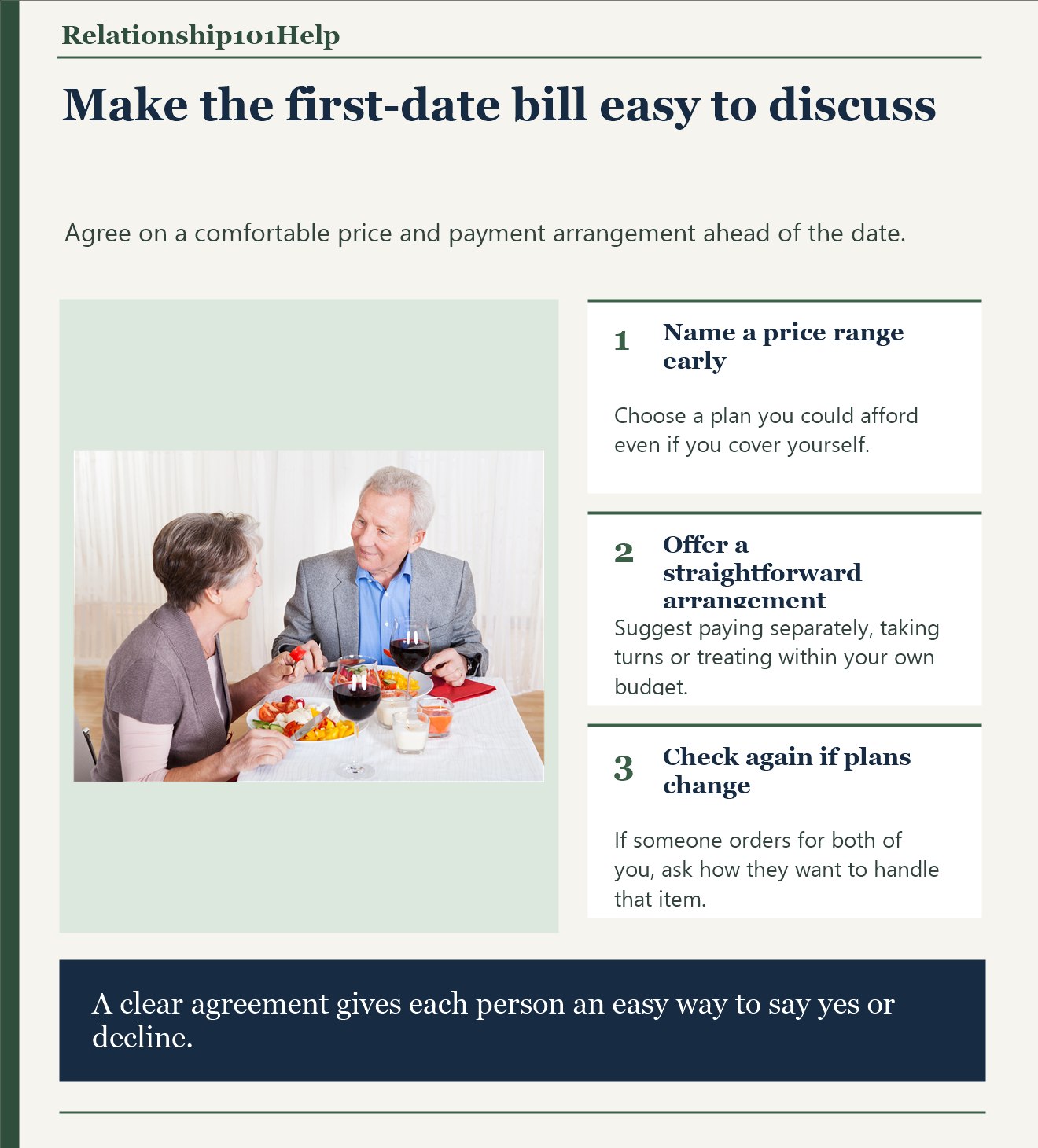
Read the infographic in text
Make the first-date bill easy to discuss
Agree on a comfortable price and payment arrangement ahead of the date.
- Name a price range early Choose a plan you could afford even if you cover yourself.
- Offer a straightforward arrangement Suggest paying separately, taking turns or treating within your own budget.
- Check again if plans change If someone orders for both of you, ask how they want to handle that item.
A clear agreement gives each person an easy way to say yes or decline.