

A lie can leave you questioning the event, the explanation and whether you can rely on the next promise. You do not need a stereotype about men or women to take that uncertainty seriously.
Focus on what you know, what remains unclear and how the other person responds. An explanation for dishonesty does not erase its effect or decide what you must do next.
On this page
Be clear about what does not fit
Write down the specific contradiction or agreement that concerns you. “You said you were working late, and later told me you were elsewhere” is something you can ask about. “You must be cheating” adds a conclusion that the information may not establish.
Leave room for an error or misunderstanding where that is possible. At the same time, you do not have to ignore repeated contradictions because you cannot know every detail.
A pause, a facial expression or an uncomfortable conversation is not enough on its own to settle what happened. Look at the information you can describe and the pattern over time.

Distinguish privacy from a false impression
A partner can want time alone, private conversations or room to understand a feeling. Closeness does not require reporting every thought or sharing every password.
Privacy is different from deliberately giving information that misleads someone about an agreement or a decision affecting them. You can discuss what needs to be shared while respecting each person’s separate life.
If someone wants an evening alone, a direct answer leaves you better able to make your own plans than an invented work commitment. The need for space can be reasonable while the dishonesty still needs attention.
Ask a clear question when it is safe to do so
Choose the concern you want to understand: “Can you explain the difference between those two accounts?” or “What happened to the agreement we made?” Give the person room to answer without supplying the excuse for them.
You can describe the effect: “I am finding it difficult to plan around what you tell me.” This keeps the discussion connected to a real consequence.
If you fear threats or retaliation, do not make confronting the person your first obligation. Seek private support and consider what is safer for your circumstances.
Listen for accountability as well as a reason
People can give different explanations for lying, including avoiding a difficult conversation, embarrassment or wanting to conceal a choice. You cannot know which applies simply from someone’s gender.
A useful response acknowledges what happened and its effect without making you responsible for the decision to mislead you. “I was afraid you would be upset” can describe a feeling; it does not mean you caused the lie.
You can reflect on how both of you handle disagreement while still holding each person responsible for their own honesty. These are related conversations, rather than reasons to excuse one another’s choices.
Make repair specific and voluntary
If you both want to continue, discuss what needs correcting now and what would make future agreements clearer. That may include correcting a false account, addressing a practical consequence or communicating a changed plan promptly.
Repair should not require permanent surveillance. Access to passwords, location tracking or repeated demands for proof do not automatically create a relationship you can trust.
You can decide what you need and hear whether the other person is willing to participate. Neither an apology nor a promise obliges you to forgive immediately or stay.
Notice repeated harm and protect your support
Look at what follows the conversation. Are accounts becoming clearer, commitments being kept and mistakes being acknowledged? Or do explanations keep changing while you are blamed for asking?
You do not need to win an argument about someone’s entire character to decide that an arrangement is not workable. Keep access to trusted people and practical support while considering your options.
If deception sits alongside coercion, intimidation or isolation, get appropriate private support rather than relying on a communication exercise to make the situation safe.
Choose the next step you can own
You may want more information, a period to reflect, a practical boundary or a decision to leave. Choose a step that fits what you know and what you can manage.
Avoid waiting indefinitely for certainty about every motive. You can take the effect of a pattern seriously even when the person gives an explanation you cannot verify.
The useful question is not whether all people of a particular gender lie. It is whether this relationship offers the honesty, accountability and freedom you need.
When an agreed bill was never paid
If a partner said a shared bill was paid but you receive a late notice, ask what happened and check that you understand the balance. Discuss who will handle the missed payment and what you can afford to share going forward.
Repeatedly checking someone’s private accounts can create its own problems. If the pattern affects your housing or money, seek independent support and think through what you can protect.
Read the infographic in text
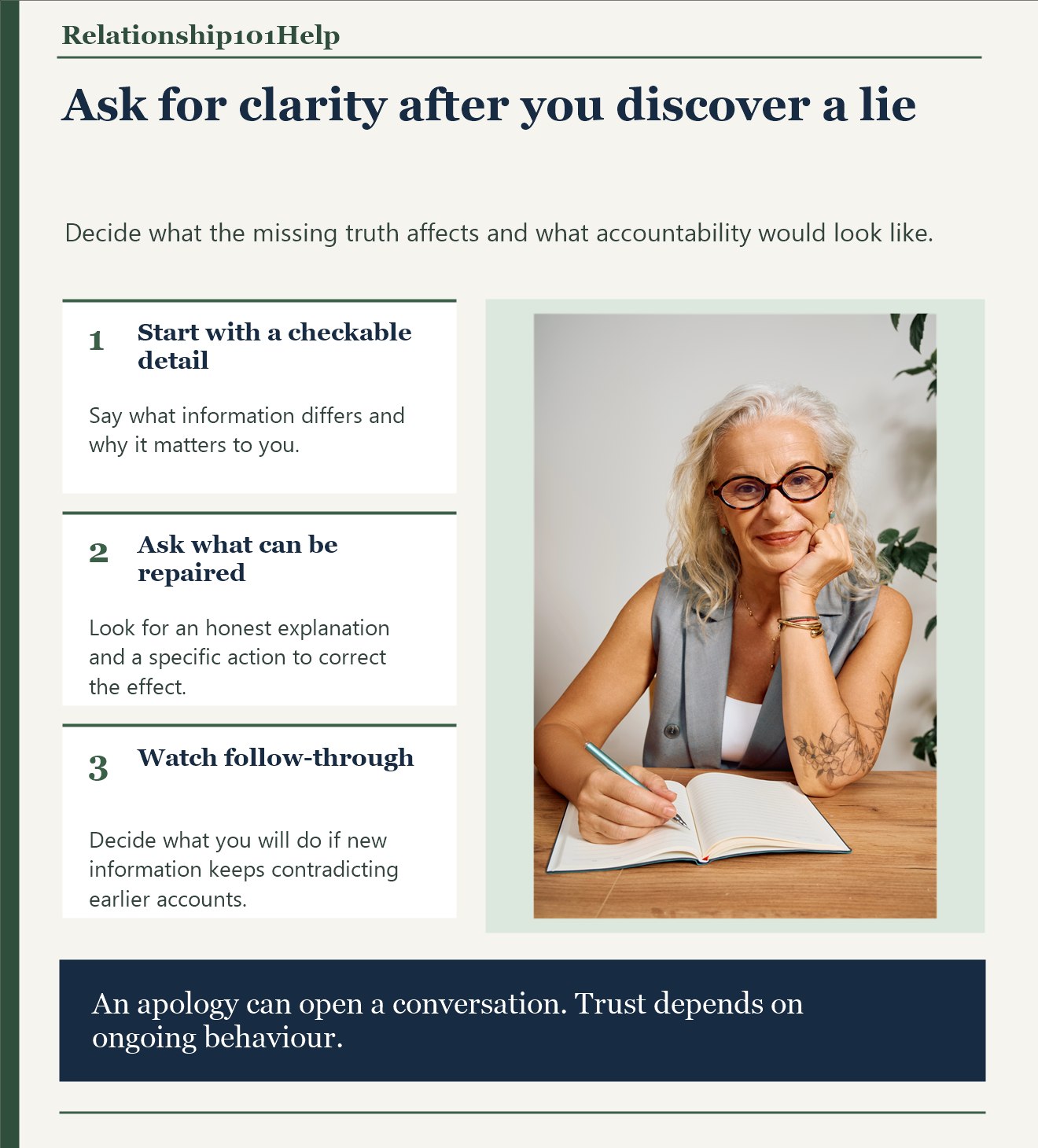
Ask for clarity after you discover a lie
Decide what the missing truth affects and what accountability would look like.
- Start with a checkable detail Say what information differs and why it matters to you.
- Ask what can be repaired Look for an honest explanation and a specific action to correct the effect.
- Watch follow-through Decide what you will do if new information keeps contradicting earlier accounts.
An apology can open a conversation. Trust depends on ongoing behaviour.